The 2026 Global to Regional km-scale hackathon will take place at the Met Office Collaboration Building, Exeter, on 18-22 May 2026. A hierarchy of km-scale Met Office Unified Model simulations, from regional to global, will enable analysis of atmospheric phenomena over convective to planetary scales. It is part of the World Climate Research Programme (WCRP) effort to push the boundaries of climate system modelling and digital innovation.
Welcome
Prerequisites
Registration
Venue
Programme
Accommodation
Science Plan
Software Stack
Contact
Prerequisites
During the hackathon climate data from km-scale simulations with the Met Office Unified Model will be provided in Healpix format at different zoom levels. Jupyter Notebooks will be provided to explain the basics of the data handling. Participants can then develop their own Jupyter Notebooks or python scripts to analyze and plot the data.
Participants are expected to have basic knowledge of:
- Linux terminal
- Python, including Matplotlib, Numpy, Xarray
- Concepts of data visualization
- Handling of global 2D and 3D data in Climate science or similar fields
Registration
Registration is now closed. The registration deadline was Friday 17th April 2026. If you would still like to join, please complete the form below and we will confirm your registration if this is possible.
Please use this Microsoft Form to register your interest and state which days you will join for. The questions will help us to make sure everything is arranged for the hackathon to run smoothly. Note that this event is free - there is no registration fee. The Met Office will provide lunch and snacks during the working day, we hope to plan a group meal on evening of Wed 20 May.
Venue
The event will take place at the Met Office Collaboration Building (Met Office HPC Complex) in Exeter. Please note that the Collaboration Building is a 20-minute walk from Met Office HQ (on the opposite side of the M5). See accommodation options below. The Exeter Science Park (and Collaboration Building) are served by the 4A bus service from Exeter city centre. The postcode for directions to the Collaboration Building is EX5 2FS.
Programme
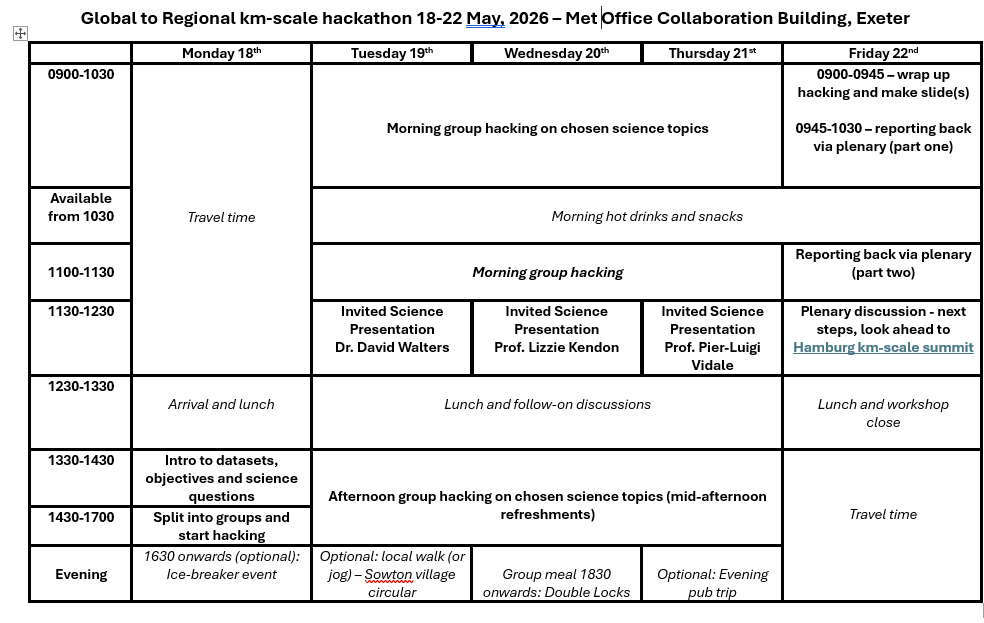
The 2026 UK K-Scale hackathon will run from lunchtime on Monday May 18 to lunchtime on Friday 22 May. Lunches will be provided at the Met Office Collaboration building each day. The draft timetable for the week is linked below.
Accommodation
Please organise your own accomodation for the week. The hackathon will take place in the Met Office collaboration building which is on the opposite (east) side of the M5 to Met Office HQ and part of the Exeter Science Park. The collaboration building is approximately a 20 min walk from Met Office HQ so staying at the Holiday Inn or Premier Inn (both of which are next to Met Office HQ is one option). Alternatively there is a new hotel at the Exeter Science Park, Voco Zeal, which is approx. 5 min walk from the collaboration building. Some may want to make use of the multiple hotel options in Exeter City Centre, the 4A bus from the city centre goes to/from the science park but allow additional time during the morning and evening rush hour.
Science Plan
A K-Scale model hierarchy, encompassing a set of year-long global and regional domain simulations across a range of grid resolutions and science options. This is designed to enable analysis of a range of research questions. This year’s event builds on the 2025 WCRP Global Hackathon which aimed to: drive advances in high-resolution models; to promote and share best practices for coding and workflows; and to foster a global community with open access to datasets. The 2025 event established a number of working groups through the UK event hosted in Oxford. For this 2026 UK event, the Global to Regional km-scale hackathon, will tackle a range of questions in the context of developing evidence to address two over-arching hypotheses:
A: Better representing mesoscale phenomena, such as details of local-scale convection, feeds back on the large-scale atmospheric circulation.
B: Development of high quality, high-resolution global simulations generates new information that may be of value for enhancing development of machine learning approaches to weather and climate prediction.
A number of data sets will be made available on the JASMIN object store, in HEALPix format, and accessible remotely. Notebooks to perform the analyses above, at least at an initial stage, will be provided to all, including catalogues for data discovery. Observational products will also be provided, e.g. ERA5, IMERG, CERES. Many of the more complex data sets, e.g. TC tracks, MCS tracks, will be provided before the event. Multiple working groups will be formed around topics linked to addressing the hypotheses above, and will work together at the venue. Potential working group themes might include:
- Tropical and Extra-tropical cyclones
- Monsoon circulations and energetics
- Tropical wave activity, propagation and tele-connections
- Mesoscale convective systems
- Upscale influence of mesoscale phenomena on the large-scale circulation – utilising the local scale-to-scale energy transfer tool LoSSETT
- Land surface interactions
- Clouds and radiation
- Further topics of interest to be added ahead of and during the hackathon
Across each of these groups, it may be useful to consider:
- How do the characteristics of the phenomena of interest differ between global and tropics-wide domain simulations with explicit representation of convection [i.e. using the RAL3.3 science configuration] relative to a benchmark high-resolution weather/climate configuration with parametrized convection [GAL9]?
- What impact does use of a new convection parametrization scheme (CoMorphA, adapted to higher resolution) have on results?
- How sensitive are representation of regional phenomena to the domain extent of high-resolution simulations – are there notable differences between global and tropics-wide simulations with explicit convection to benchmark regional Limited Area Models using the same science configuration?
- How do biases evident in the hierarchy simulations compare to any known persistent biases related to phenomena of interest in coarser resolution climate models? Are there any sensitivities (e.g. magnitude, sign, extent) to the choice of science configuration, domain extent, or grid resolution of the 1-year hierarchy simulations?
- Given the majority of current generation global machine-learning weather prediction models are trained using ERA5 reanalysis data, how does the representation of phenomena differ in the K-Scale hierarchy simulations? Are both or either representations physically realistic when compared to available observations?
Software Stack
Here are some steps to get you started for the hackathon. These should be done before the hackathon begins.
1. Hackathon python environment and notebooks
In order to be able to run the notebooks provided for the hackathon and conduct data analysis using the tools for the hackathon, the official global hackathon software stack needs to be installed. Please follow these instructions to get yourself set up with a working Python environment on JASMIN (or locally).
There are notebooks that give examples of how to access the data, and links to take you to support pages.
2. Further reading
If you would like to learn more about the healpix format in which all the model data is stored please follow this link.
If you want to see a high-level overview of last year’s WCRP global, km-scale hackathon, read this BAMS article. There is an in-preperation GMD article which goes into more detail on the software stack.
Contact
Richard Jones richard.w.jones@metoffice.gov.uk
Mark Muetzelfeldt mark.muetzelfeldt@reading.ac.uk